Mary
Player Manager: A Sports Progression FantasyMary, Max Best’s mother, is a seriously ill woman living in a care home whose condition initially appears to be moving in only one direction: decline. Yet her appearances complicate that expectation. She is often unable to remember passwords, her lucid moments do not reliably coincide with Max’s visits, and the doctors encourage him to keep trying while nurses assure him that his presence helps. Through Anna, Solly, cards, tea, and the ordinary routines of companionship, Mary becomes not merely the source of Max’s anxiety but a person whose capacity for connection unexpectedly returns.
Identity and Circumstances
Mary is Max’s mother, though Max describes their relationship as undemonstrative even before her illness. They had never been people who held long conversations, and after her condition worsens, visiting often becomes an exercise in what he calls “being there.” The phrase captures both his devotion and his helplessness: he continues to visit even when Mary cannot recognise him, because the medical staff say that his presence benefits her, but he has no dependable conversational route back to her.
Her illness is presented as progressive and incurable. Max states plainly that she is not well and is not going to get any better, establishing a medical and emotional horizon against which every later improvement registers as improbable. The care home itself is part of that horizon. Max notices the institutional disruption when patients are moved from room to room, and he objects that familiar places and routines ought to matter. Mary’s insistence on moving rooms nevertheless reveals a will that remains active beneath the condition, especially because such behaviour is unlike her usual refrain, “Don’t make a fuss.”
Recognition, Friendship, and the Care Home
Mary’s most important early reversal comes when she recognises Max immediately and gives him an urgent instruction: he must see Anna next door. Rather than asking for rescue or complaining about her circumstances, Mary directs him toward a friendship that matters to her. She wants to be beside Anna because Anna is her friend, and the request supplies Mary with a social world extending beyond the mother-son relationship.
Max introduces himself to Anna as Mary’s son and explains that he has heard the women are friends. Anna describes them as “Thick as thieves” and adds that Solly adores Mary. The exchange places Mary inside a network of affection that Max has not created and cannot control. Her life in the care home is therefore not reduced to medical observation or family duty; it includes alliances, loyalties, and the possibility of being known by someone other than her son.
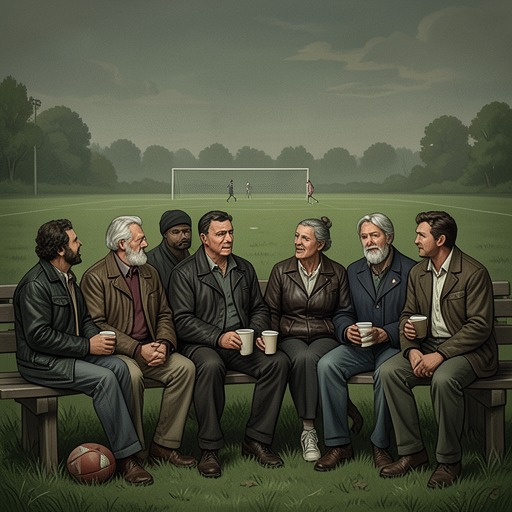
The friendship also changes the emotional texture of Mary’s condition. Later, after Max has worked with Beth and the Beth Heads, he visits Mary after lunch, when the care home is more cheerful and sleepy, and takes tea in the grounds. The setting is modest rather than idyllic, but it offers a contrast with the dark, damp, narrow streets and alleys of Moss Side. Mary, Anna, Max, and Solly play cards together while the Dog lies on Mary’s feet, occasionally standing, turning, and settling again. The scene’s importance lies in its ordinariness: a woman whose illness had seemed to erase continuity participates in a familiar-seeming domestic ritual.
Recovery Through Ordinary Life
Max interprets Mary’s change through the presence of Anna. He feels that Anna is curing her, not by staging a dramatic struggle or fight but by enabling Mary to move away from the disease. The evidence is physical as well as emotional. Mary’s dexterity has improved enough for her to deal the cards, slowly but successfully. The recovery is therefore not described as a miraculous declaration but as a series of small restored actions: recognising people, choosing where to live, maintaining friendship, joining a game, and handling cards.
This improvement reverses Max’s established expectation that every visit will show Mary slipping further into her illness. The value shift is from helpless witnessing toward shared activity. Max still remains aware of the care home’s limitations, but the card game gives him a form of presence that is not empty. The family scene does not cure the underlying condition in any medically confirmed sense; rather, it changes what Mary and the people around her can do together. The distinction matters because the book locates her renewed vitality in relationship and environment, not solely in an abstract battle against disease.
That recovery is fragile. During a later visit, Mary’s lucidity rises far enough for her to realise that she does not know the people around her. The gathering includes Max, Beth, Jackie, and Ziggy, and Beth explains that they know Max through football and that he is helping their team prepare to play Manchester City. Mary’s recognition of her own unfamiliarity interrupts the social warmth of the meeting. Her condition is not steadily repaired; lucidity itself can expose loss by making the gaps in memory visible.
Mary and Max’s Changing Perspective
Mary’s illness stands in sharp contrast to Max’s habitual approach to football. He is fascinated by data, player attributes, tactical interfaces, and systems that promise to make hidden structures visible. He complains that match commentators praise tactical adjustments he cannot perceive, even when freeze-frames make the worst teams look like the best. Later, the curse supplies him with increasingly elaborate screens: a profile showing experience points and achievements, a news feed announcing “Perk Unlocked: Super Scout,” and a match interface with tactical columns, statistics, action zones, and a match report.
Mary cannot be understood through that kind of totalising display. Her condition is not a fixed score, and her identity cannot be recovered by reading a numerical profile. Max can examine acceleration, pace, technique, handling, formations, match reports, and corner-kick patterns, but his mother’s most consequential changes appear in gestures and intervals: an unexpected recognition, a demand to be moved beside a friend, a slow deal of cards, or a lucid moment that turns a room of visitors into strangers. The narrative places these human uncertainties beside Max’s desire for measurable certainty and makes the contrast increasingly difficult for him to ignore.
Even Max’s emerging football intelligence is shaped by embodied observation. Recalling the 2006 World Cup, he explains that he compared defenders with Fabio Cannavaro and became interested in balance, bodily control, and the discipline of doing only what one had mastered. He learned to copy players’ movements, though consistency remained a problem. His later analytical tools similarly convert matches into searchable patterns: after wanting a control-F function for corner incidents, the curse reprograms the interface so he can filter the report. Mary’s story quietly resists this conversion of life into searchable evidence. What matters about her cannot be isolated as a single event type or captured by a tactical screen.
Narrative Role and Significance
Mary is both a vulnerable person and a structural counterweight to Max’s football fantasy. Her illness gives the story an intimate field of consequence outside the game, while her unexpected improvement prevents that field from becoming a simple tragedy. The care home scenes repeatedly interrupt Max’s enthusiasm for XP, perks, management, and scouting with questions of memory, dependency, routine, and recognition.
Her relationship with Anna is especially significant because it reveals that care can be social rather than exclusively familial or medical. Max arrives as the son who is expected to be present, but Anna supplies a different kind of companionship, one that seems to restore Mary without demanding that she explain or overcome her illness. Solly and the Dog further surround the card-playing scene with a non-instrumental form of affection: Mary is included in a small community rather than treated as a problem awaiting a solution.
Mary’s ending, as represented in these episodes, remains unresolved rather than conclusively healed. She can improve and relapse; she can recognise Max and later fail to recognise his companions; she can seem to move away from the disease while still living within its effects. That instability gives the character her depth. Mary is not merely a symbol of loss, a reason for Max to grow, or an obstacle to his football ambitions. She is a person whose changing capacity for memory and action forces Max to encounter a form of knowledge that his screens cannot supply: the knowledge that care is measured less by control than by sustained presence.